From Shopping Mallsto Family Destinations
Executive Recommendation
Palisades Center can become the Northeast’s leading recurring family destination by connecting its existing retail and entertainment offer to a stronger program of family play, children’s enrichment, celebrations, and large events. The objective is not to fill individual vacancies with disconnected attractions. It is to make the entire mall a coordinated family ecosystem that gives households reasons to arrive, stay, spend, return, and recommend the destination.
The recommended strategy has three demand engines: entertainment attracts family trips and weekend visitors; scheduled development programs create weekday habits; and a continuous event calendar produces local publicity, new audiences, and reasons to return. Food, parent amenities, celebrations, small play points, and a shared digital membership system connect the engines and spread their benefits across the property.
Research Evidence and Strategic Conclusions
Industry evidence, published academic studies, and our recent research point toward a shift from equipment-centered attractions to a family-centered, continuously programmed destination. The following conclusions distinguish observed research findings from proposed commercial applications.
| Finding | Evidence | Implication for malls |
|---|---|---|
| 57% weekly; 95% monthly | ICSC’s June 2026 survey: respondents visiting shopping centers or retail districts with children. | Family-oriented retail trips form a routine; a focused destination can compete for a larger share. |
| 79% interested in events | Surveyed parents said regular family-focused events or activities would make them more likely to visit. | Run regular, useful programs; measure conversion from stated interest to actual visits. |
| 86% consider experiences | Surveyed parents reported family-friendly experiences influence destination choice. | Entertainment and enrichment can differentiate a mall beyond its tenant list. |
| 22.6 million unmet | Children whose parents would enroll them in afterschool programs if available, Afterschool Alliance 2025. | Test accessible, affordable enrichment and class clusters. |
| 65% value STEM | Among parents with children in afterschool programs, 65% valued STEM when choosing a program. | Math, coding, robotics and science have a clear role beside arts and sports. |
| Engagement matters | A mall-event study found actively engaged audiences reported stronger shopping and revisit behavior. | Use participation, challenges and showcases—not only passive performances. |
| Cross-shopping is not automatic | A 2023 transaction-data study found cinema visits did not reliably increase subsequent retail purchases. | Connect attractions with retail and food through physical design and targeted offers. |
| Frequency can change | Tanger reported selected centers with strong F&B saw guest frequency rise from about 3–4 visits/year to 3–4 visits/month. | Coordinated food and experiences can create more habitual destination trips, but results must be validated locally. |
What our 2026 research adds
Our recent parent interviews, surveys, experiments, and publications identify the practical mechanisms behind sustained family visitation: https://research.futureexperiencepark.com/#current-studies
Whole-family value: parents assess total cost, safety, cleanliness, food, multi-age compatibility, their own comfort, and whether a visit has a reason to recur, not only the number of attractions.
Dual loyalty: the child must want to return and the parent must approve the price, convenience, developmental value, and overall experience.
Novelty decay and habituation: a physically unchanged attraction can become psychologically familiar; dynamic missions, themes, difficulty, and social recognition create new reasons to participate.
The progression gap: repeated admission is weaker than repeated achievement. A child should carry levels, creations, skills and milestones into later visits, so visit five builds on visits one through four.
Parent waiting-time economy: while children learn or play, parents can shop, dine, work, use services, or participate in a parallel experience. The facility must deliberately design for these choices.
Activity diversification: a family platform combines physical play, STEM, creativity, social connection, entrepreneurship, celebrations, food, and visible accomplishments.
Three Complementary Traffic Engines
Family entertainment and celebrations
Expand the number and quality of complementary entertainment attractions. A strong attraction mix gives households more reasons to choose the center, serves different ages, encourages group and birthday visits, and can extend time on property through combined activities. IAAPA has documented the role of attractions in mall repositioning; Mall of America and American Dream are high-profile demonstrations, although their flagship scale is not a direct forecast for a regional mall.
Children’s development and enrichment
Create a visible multi-provider district for mathematics, reading, coding, robotics, science, art, music, dance, chess, languages, entrepreneurship and sports. Classes, clubs, camps, competitions and workshops can generate scheduled afternoon and evening visits as well as school-break traffic. Combine short programs so a family can coordinate two children’s activities at one location. Accessibility and reasonable pricing matter: the Afterschool Alliance identifies cost and inconvenient locations as major participation barriers.
Large events and a continuous calendar
Use indoor galleries and vacant spaces for Family Expos, Children’s Business Fairs, STEM festivals, contests, maker markets, performances, school showcases, community celebrations, seasonal programs and family challenges. Favor participatory experiences that give people a reason to stay, explore other floors and return. Unlike outdoor event sites, the mall can provide weather protection, parking, dining and restrooms, subject to capacity, access and operational approvals.
Palisades Center as a Flagship Implementation
Palisades Center, already has a significant head start. In February 2026, it was reported approximately 12 million annual visits and a 70% trade area exceeding 2.2 million people, with average household income above $150,000 and approximately 87 minutes of average dwell time. These figures establish a substantial audience but do not show the distribution of traffic by floor, daypart, visitor age, or reason for travel.
The objective is to transform existing volume into stronger household loyalty and purposeful trips to a connected family destination. This requires improving attractions that already exist, adding complementary ones, activating upper floors, and building a visible calendar and a shared digital journey.
A coordinated level by level plan
| Location | Proposed role | Action |
|---|---|---|
| Level 4: former Barnes & Noble | Flagship family entertainment park and event district | Plan approximately 29,000–30,000 SF of mixed-age play, development-rich digital experiences, party rooms, parent hospitality and visibility into the gallery. Subject to 2027 space delivery and agreement. |
| Levels 1-4: Palisades Climb | Visible vertical landmark and recurring challenge platform | Upgrade lighting, graphic identity, digital missions and recognition; connect the course to weekly activities across four-floor views. |
| Level 4 galleries / flexible space | Weekend Family Expo and event campus | Host large Saturday/Sunday fairs, showcases, competitions, previews and seasonal destinations. |
| Level 3: ClimbZone and dining | Skill progression and family food connection | Add optional structured climbs, small digital challenge displays, prize/achievement integration and restaurant offers. |
| Level 2: former Foot Locker B204 | Children’s development and enrichment hub | Test classrooms, studios and labs in approximately 9,004 SF, with further locations for specialist providers. |
| Levels 1–3: circulation points | Mini discovery play and family wayfinding | Install compact, safe, rotating play or challenge islands that introduce the destination and guide visitors across floors. |
Flagship Park and the Broader Entertainment Mix
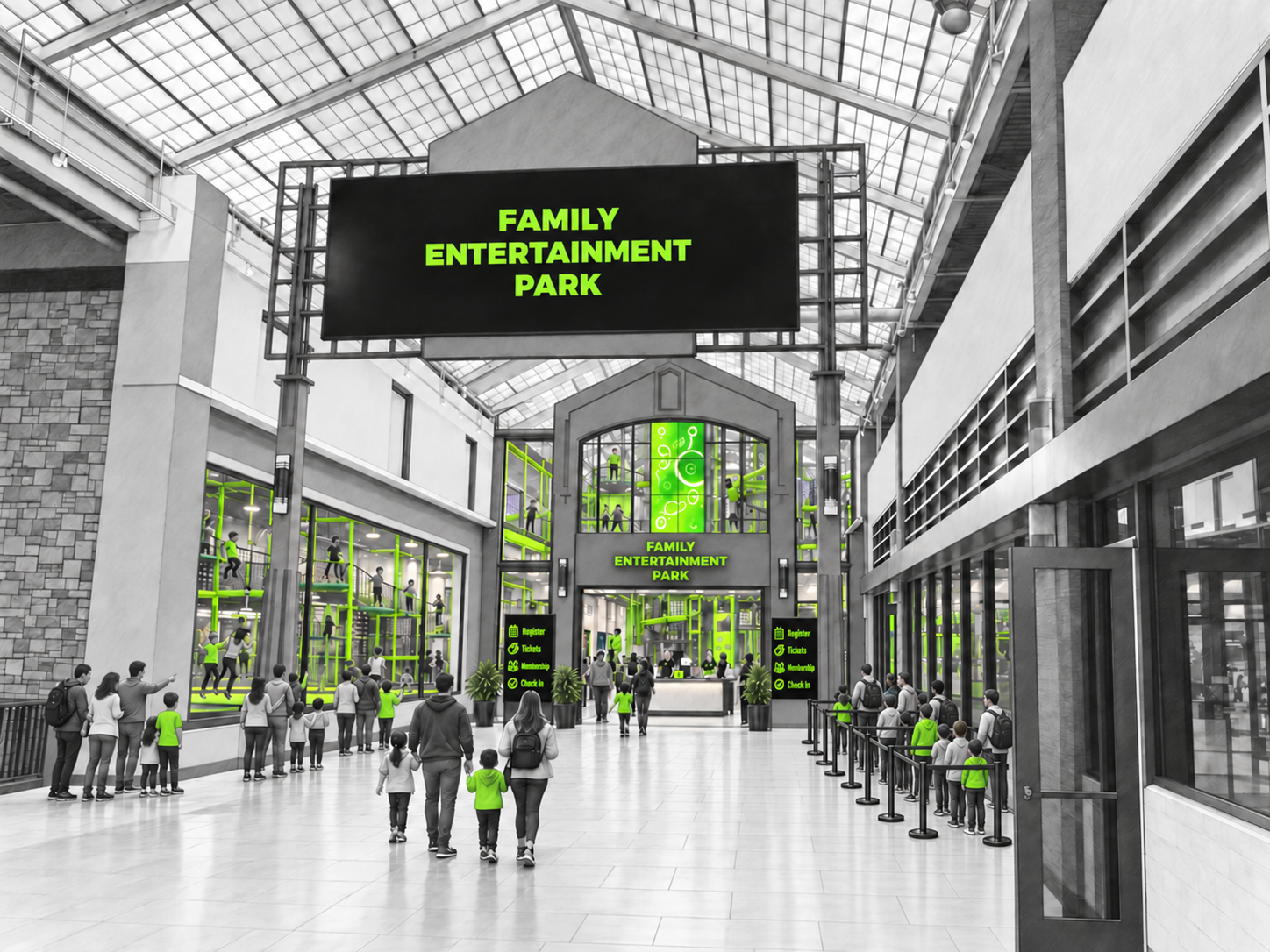
The flagship park should be a reason to travel to Palisades, not a substitute for existing tenants. The earlier Palisades concept proposed the complementary strengths of Leo&Loona for roughly ages 1–8 and Zamania for roughly ages 7–14, integrated with Future Experience Park exploration, creative and developmental zones. The ages overlap intentionally to serve siblings and developmental differences. Digital and interactive experiences, parent comfort, party capacity, and shared memberships link the offer. Exact activity admission should follow appropriate age, height and supervision rules.
The former Barnes & Noble site offers a mall-gallery frontage and a direct parking-side entrance. These should serve two customer flows: impulse discovery from the gallery and destination arrival for pre-booked parties, members, camps and school groups. A clear view of active play and live scores helps pedestrians understand the attraction within seconds.
The park will complement other Level 4 operators rather than duplicate them.
Revitalizing the Ropes Course and Climbing Experience
Palisades Climb as the signature visual landmark
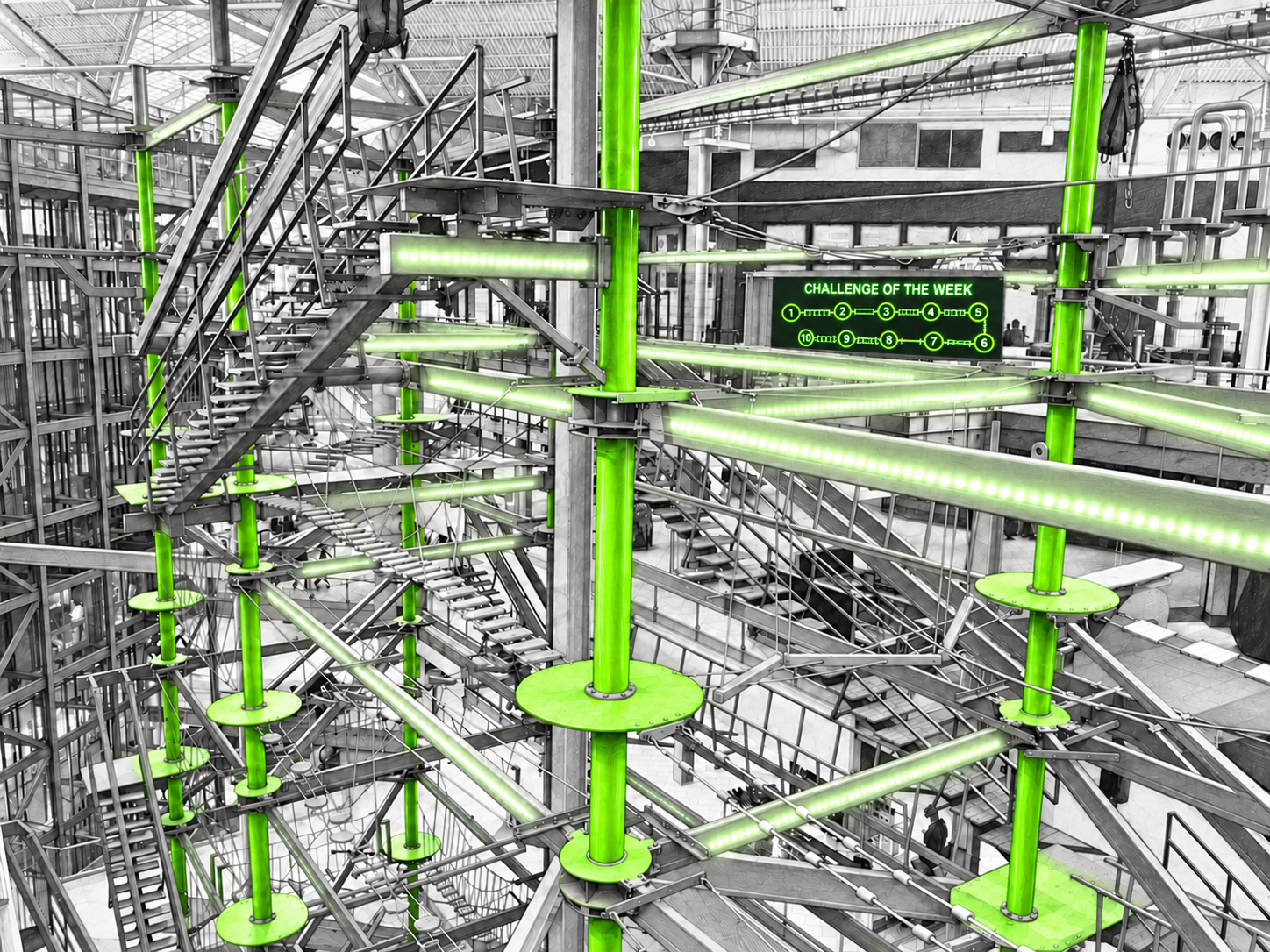
Palisades Climb a major indoor ropes course. Its potential advantage is vertical exposure to traffic across the atrium. Yet a technically impressive installation can be overlooked when its colors, lighting and messaging do not create immediate visual recognition, especially after dark. Commission a sightline and lighting assessment from all four levels, then develop high-contrast identity colors, safe architectural lighting, illuminated wayfinding, visible countdowns, and changing challenge information. Any alterations must preserve safe operations and operator approval.
The larger opportunity is programming. Familiar obstacles create habituation; eventually a repeat visitor knows the course too well. Introduce a weekly mission ladder: an introductory route, timed balance task, teamwork challenge, precision mission, and advanced achievement. Keep the underlying equipment where appropriate while changing the task, narrative, scoring, and recognition. Offer weekly challenges and seasonal finals so participants can earn visible status through genuine improvement, not merely spending money.
ClimbZone on Level 3
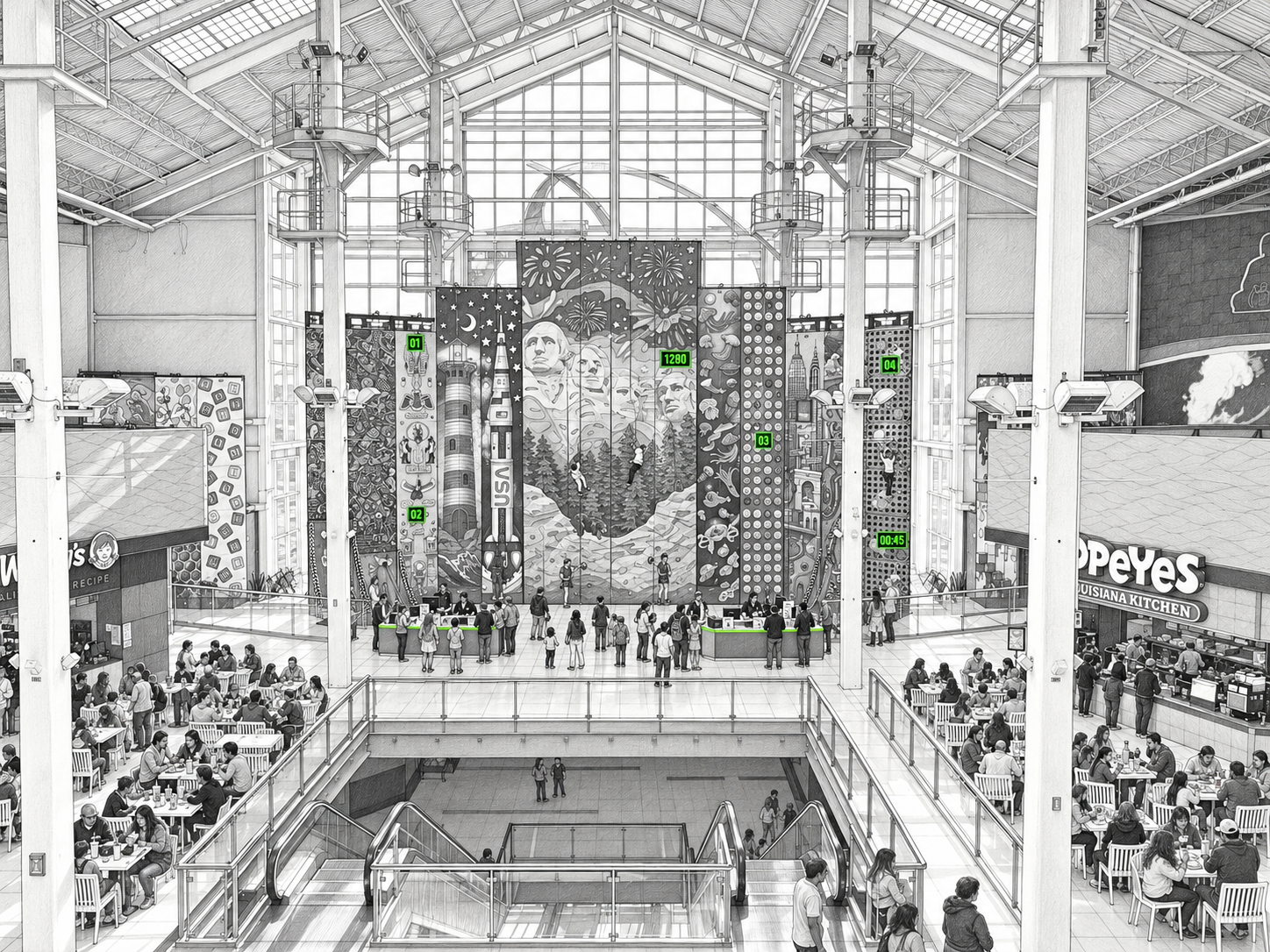
Connect the climbing experience to the same progression program through route-specific mini displays and optional physical challenge cards: reach designated holds, solve a puzzle before a climb, complete a teamwork relay, or unlock a harder route. Small screens should show age-appropriate missions and progress without distracting from instructor oversight. Tie achievements to the family account, with recognition delivered on an opt-in basis.
The park, ropes course and climbing experience can feature shared monthly themes, such as Space Mission, Mountain Expedition, Robotics Rescue, Ocean Science or Future City.
One Digital Family Identity and Rewards Economy
Create a single Family Entertainment Account across participating attractions, enrichment providers, events and food tenants. A parent can manage family profiles, waivers where relevant, reservations, memberships, class bookings, birthday planning and reward balances. A QR code or wristband can identify authorized activities, while each operator retains its own safety and capacity controls.
How the progression and redemption loop works
A family attends the park, ropes course, climbing wall, workshop or event. The child selects a relevant weekly mission and receives a digital or paper task.
Staff or an approved device records completion, improvement or participation. The child earns experience points, badges and a next level. Points can recognize effort, teamwork, creativity and skill, rather than only spending.
The family sees new challenges before the next visit. The child returns to finish a series, improve a record, reach a level, or unlock a reward. Seasonal tournaments and school/team missions add social prestige.
Parents can choose to redeem eligible points for a participating tenant benefit: a short attraction add-on, café treat, birthday accessory, discounted event ticket or sponsored merchandise. A shared ledger records redemption and the agreed reimbursement or promotion cost for each partner.
The profile grows with the child over time—new activities and age-appropriate missions replace old ones. Parents manage consent and data sharing; public rankings and identifiable child profiles remain opt-in.
Implementation should be phased. Start with a common calendar, family passport, cross-referral coupons and shared rewards among willing partners; add integrated ticketing, a multi-attraction pass, and household memberships after commercial settlement, tax, technical and operator terms are agreed. A single customer experience does not require every tenant to surrender its existing point-of-sale system.
Food, Parent Comfort and Small Play Points
Position food as part of the family itinerary rather than an afterthought. Develop a complementary network of cafés, restaurants, quick-service food and family-friendly snack locations on Levels 2 and 3 and, where feasible, integrated with the Level 4 park. A parent who can comfortably work, drink coffee or enjoy lunch while children attend scheduled classes has a more attractive reason to keep the household onsite.
Cross-promote through simple packages: class plus afterschool snack; two-attraction family ticket plus dining offer; birthday party plus group meal; Sunday challenge plus restaurant reward; and a joint family membership with selected food benefits. Avoid forced bundles and opaque charges. Our food research emphasizes clear value, familiar food choices, operational simplicity and parent satisfaction.
Introduce small, visually attractive discovery play points at selected galleries and circulation nodes. These must be age-appropriate, hygienic, safely separated from traffic and accessible, with a clear path to the flagship park or scheduled activities. A free five-minute activity can generate awareness without substituting for a premium, ticketed attraction.
An Event Every Weekend and Activity Throughout the Day
The Fourth Floor should be the visible weekend event nucleus, while the park, ropes course, climbing wall, developmental studios, dining venues and party areas host supporting programs. Build the calendar on four timescales, an approach developed in the Destiny USA district strategy: annual signature occasions create regional publicity; monthly themes create novelty; weekly formats create habits; hourly activities make the building feel alive.
Events bring direct visitors, but their marketing value can be equally important. Every credible event can appear on the Palisades website, local family calendars, Eventbrite, Facebook Events, school and PTA communications, community newsletters, local magazines, tourism listings and relevant professional calendars. Each listing repeatedly associates the activity with Palisades Center. Consistent publication turns the mall from a passive address into a recurring regional story. Partners, schools and exhibitors amplify reach through their own communities.
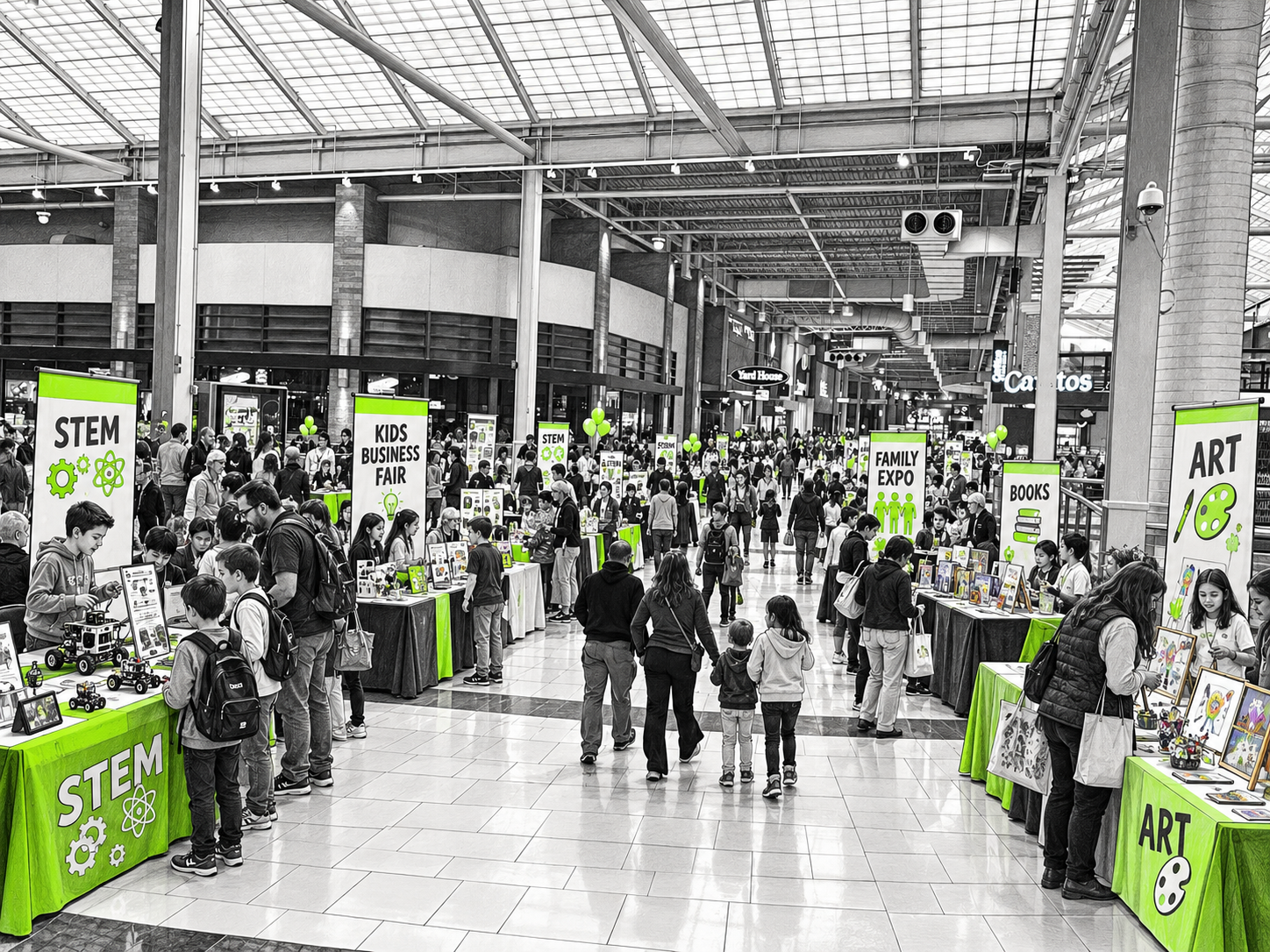
The format should include activities rather than only promotional booths. Our Family Expo and Children’s Business Fair formats already provide an event platform for schools, young entrepreneurs, teachers, science and coding organizations, libraries, sports operators and community partners. A three-month pre-opening Family Expo can also serve as a demand test, lead-generation event, partner discovery mechanism and founding-member launch for the flagship park.
| Rhythm | Illustrative Palisades programming |
|---|---|
| Every Saturday | Family Expo modules; Children’s Business Fair; maker and robotics demonstrations; art, music and sport workshops; ropes and climbing challenges. |
| Every Sunday | Family Challenge Day; North Jersey Sunday special; family treasure hunts; parent-child competitions; live performances and birthday discovery programs. |
| Weekday afternoons | Math/coding/robotics/music/art classes; school and club programs; short afterschool physical challenges; parent café offers; homeschooling programs. |
| Every hour in active zones | Short hosted missions, micro-contests, demonstrations, story or maker sessions, birthday celebrations and photo moments. |
| Monthly / seasonal | STEM festival; science fair; chess or math league; summer camp fair; themed family celebrations; creator showcase; large holiday market. |
Measurement
| Measure | Baseline and proposed tracking |
|---|---|
| Destination traffic | Property-level visits; Level 4 and Level 2 counts; new vs repeat household arrivals; Saturday/Sunday and weekday dayparts. |
| Dwell time | Compare a landlord-reported 87-minute historical center benchmark with measured family-program cohorts. A 120–180 minute family visit is a test target, not a proven result. |
| Cross-shopping | Opt-in surveys and anonymized tenant transaction uplift during relevant program windows; restaurant voucher use; adjacent-store conversion. |
| Habit formation | 30/60/90-day household return; class attendance; progression completion; membership activation and retention. |
| Regional attraction | Visitor-origin mix, especially Rockland/Bergen/Paramus Sunday families; school/camp group reach; first-time household share. |
| Marketing and economics | Qualified leads, events calendar reach, program cost per first-time family, net revenue, operator settlement costs, security and cleaning load. |
Final Strategic Position
The next-generation mall should not depend only on finding a new tenant to replace an old one. It should create a continuous system of reasons to return. Entertainment brings families; education brings routine; events bring new audiences and public visibility; shared digital progression turns one visit into the next. The traditional mall was built around shopping. The next-generation mall can be built around family life.
Reference Sources
- ICSC (2026), Family-Focused Retail Survey
- ICSC (2025), Q2 Marketplaces Industry Report
- Afterschool Alliance (2025), Lost Opportunity
- Afterschool Alliance (2026), Afterschool STEM Takes Off
- IAAPA (2024), How Attractions Are Resurrecting Shopping Malls
- Placer.ai (2024), Meet You at the Mall
- Sit and Birch (2014), Entertainment Events in Shopping Malls
- Lee et al. (2023), Movie Watching and Mall Cross-Selling
- ICSC (2026), What F&B and Experiential Retail Demand From Landlords
- Mall of America, Official Press Kit
- Spinoso Real Estate Group (2026), Palisades Center Acquisition and Plans
- Bergen County Government, Downtown and Retail
- Palisades Center, Palisades Climb Adventure
- Palisades Center, ClimbZone
- Godovykh (2026), What Parents Want from FECs
- Godovykh (2026), Novelty Decay
- Godovykh (2026), The Progression Gap
- Godovykh (2026), The Dual-Loyalty Model
- Godovykh (2026), Bringing Families Back
- Godovykh (2026), Pizza Wins and FEC Food
- Godovykh, How to Build the Best Activity Park